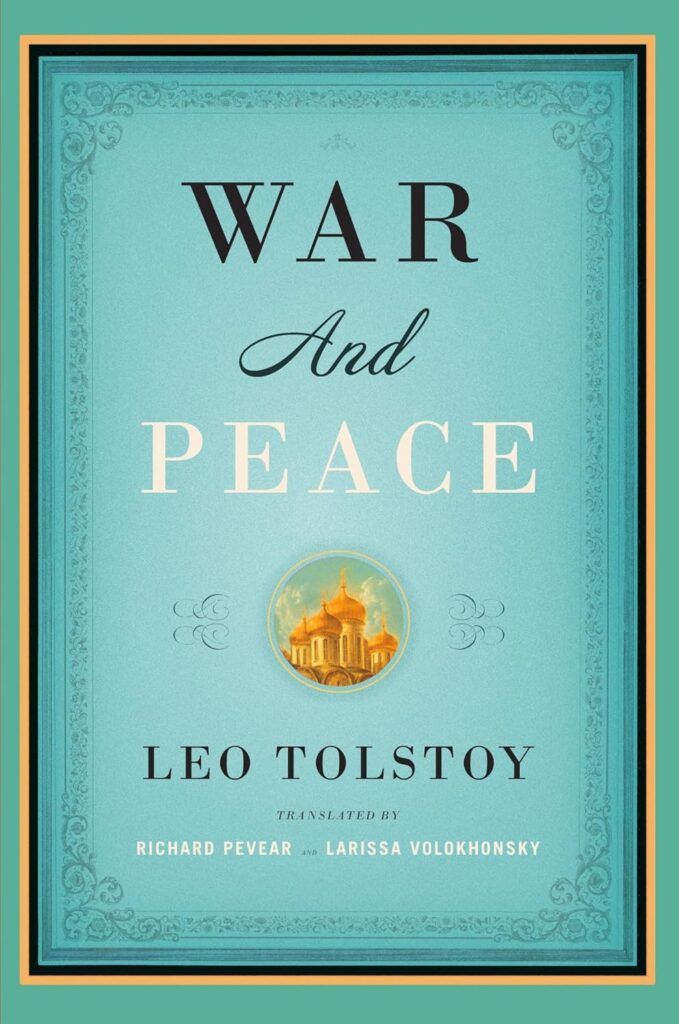
Author: Leo Tolstoy
Description: The foundational classic! There is war, there is peace, and everything in between.
Book length: Colossal (1000+ pages)
Rating: to be revealed in part II of the review!
Introduction
Another big one! This is often considered one of, if not the classic book. Everybody knows it, but maybe not that many have read it. And it is easy to see why, it is not quite your typical summer book you would bring to the beach (maybe for some it is!). The sheer number of pages can drive people away, and I feel that big Russian classics often have this kind of energy around them that people think it is very hard to read and overall a challenging reading experience. It was on my list for a long time, and I finally decided to give it a go. I had little clue what to expect, other than it being a widely regarded classic set during the Napoleonic Wars. Here I will try to gather my thoughts on the book and give you some hints of what to expect, so you can decide for yourself if this is something you would like to tackle.
This book is one that deserves a two part review, so in the first part, I will give some info on what the book is about in general, some historical context, writing style, and what to expect from the cast of characters. In the second part, I will dive a bit into the philosophical aspects of the book, my reading experience and overall impression.
So What is War & Peace?
We can start by answering what it is not – a novel. At least according to the author. There are a few pages about the book by the author himself where he talks about that, and I see what he means, but for all intents and purposes, we can treat it as a novel. If I had to summarize what the book is, I would say something like this:
It is set during the Napoleonic Wars, and takes some of the major events of that era, like the French invasion of Russia, as its backbone and overall setting. It takes that real historical settings and blends it with fiction, introducing many fictional characters, and fictionalizing some real people as well. During that time of war, there are detailed descriptions of battlefield action (the ‘War’ part). At the same time, there are still gatherings in the cities, where people do what people usually do – a mother asking for some favors to protect her son, men and women deciding whom do marry, political talks, things like that (the ‘Peace’ part.) Through all that it covers a huge amount of human experiences in life. We also get Tolstoy’s view on history in general, in terms of how to approach questions like why did this and that happen, is there some specific reason or decision behind that, or were some things inevitable either way?
Hopefully this gives you a rough idea. I would also say that under all that, social analysis and the people involved are paramount, and the historical context does not make it outdated. A lot of the core human experiences are the same what you would see today, and that is why it is relevant to this day.
The Historical Context – Napoleonic Wars
Since we have this historical context, it is worth saying a thing or two about it. The Napoleonic Wars were a huge event in European and World history, having profound consequences on how the world looks like today. You don’t really have to know a lot to enjoy the book, but having a general idea what was going on will for sure enhance your reading experience. Just knowing the context of some major events, like the battles of Austerlitz and Borodino, will help you feeling comfortable on the overall timeline and direction the story is going.
A good way to get up to speed with the real history are some YouTube videos. I highly recommend this one by Oversimplified. There are two half-hour episodes covering the Napoleonic Wars, and it is just a great mix of history and comedy. The guy behind it is a real talent, and it is one of my favorite channels on YT. Those and similar videos will give you a good sense of the historical context and help explain what led to the events covered by War and Peace.
In a nutshell, Napoleon was a talented military leader and propagandist that during the years following the French Revolution saw a quick rise to power. France became the origin of big changes by overthrowing the existing regime of kings. Since all the other big European powers were still Monarchies, they did not like this at all, they did not want revolutionary ideas spreading into their territory. That was basically at the core of this long lasting conflict in Europe. This is of course very simplified. As to what year we are talking about, the first big battle in the book is Austerlitz, which happened in the year 1805.
Translations & Writing Style
The thing with translations of Russian classics is that they can be very varied. There are different approaches the translator can take, like staying close to the original style, or making it more approachable. I wrote about this already in my Brothers Karamazov review. Therefore your reading experience can highly depend on the translation you choose.
I read my copy in Croatian, and found it surprisingly easy to read. There were some harder to read passages here and there, but all in all really not that many that I would categorize as difficult to read. The book is overall very readable in terms of pure language and writing style. I don’t know how much of that is thanks to the translation to Croatian, but I always found reading Russian classics in Croatian enjoyable. And since both languages fall under the umbrella ‘Slavic’ languages, it just makes more sense than choosing an English translation. But be aware that if you choosing an English copy, translations can vary. From what I researched, the Penguin translation by Anthony Briggs chooses an approach that is easy to read, so I would probably go with that one.
My Croatian copy was from ‘Školska Knjiga – Vrhovi Svjetske Književnosti’. An interesting ‘bug’ that I found in this edition is that they somehow messed up the print at one point in the first half of the book. A chapter abruptly ends, and a few chapters are missing (maybe 10-20 pages). I simply read those online and continued with the book so it was not a huge deal. Another ( more sad than interesting) fact is that this version is no longer in print (maybe because of this mistake?). So, at the moment of writing, there is no version of War and Peace in Croatian that you can buy new. This I feel is very disappointing. To not have one of the greatest pieces of classic literature available in your language is nothing short of shameful, and I hope this will change soon.
Book Structure
The number of volumes will depend on the edition, there are editions all in one volume, and some with multiple volumes. The book itself is divided into 4 ‘Books’, each book having multiple parts, and each part having multiple chapters.
I am happy to report that the chapters are very short, most are only a few pages. This makes the book much more approachable and easier to read. That also means even if you are very tired or do not have much time for reading that day, if you can manage 4 or 5 pages, you would still round up a chapter. I always liked that in books. It just feels easier to read 30 pages if it is 10 chapters as opposed to one. They are anyway fluidly connected, but just having this formal division makes it a bit easier psychologically, at least for me.
The Social Circle
I see no point in listing and describing every character in the book, as this can anyway be looked up on Wikipedia. Instead I will focus on some general topics regarding characters that I found interesting.
There are many, many characters in this book. When you start out, it can be tricky to remember all of them. For sure I had to backtrack a few times to check things like ”is this guy the son of that guy, or the other guy?”. Soon, however, it becomes more and more obvious who the main characters are, and you can follow them easily. Maybe I would compare it to something like Game of Thrones in that aspect – huge cast of characters with various degree of importance, but only a handful are the ‘mains’.
The cast of characters we are following are mainly from the upper classes of Russian society. Therefore things like having servants, or villagers working on the land of their lords will be a common thing. This is just a consequence of the state of society at that time. Even so, never did I feel that this is some long forgotten or out-of time world that I am reading about. The reason for that is that even if they are Russian lords, there are just people. The struggles they go through are common human experiences. Characters want to see their children taken care of, they decide whom to marry, they marry the wrong person, some are unfaithful, some regret it, some struggle with finances, some have strict fathers, some loose a loved one, etc. All of that makes it very human.
Most characters are very well written. Their inner struggles, and their interactions are the core of the book. What I really liked while reading is when you get a quick additional description of some characters actions or feeling. Some small metaphor or analogy that gives you right away the spot on feeling you need to feel. I just thought those moments were brilliant, and Tolstoy makes it look so effortless and smooth in his writing.
What I also liked is the unpredictability – no character is completely safe. You cannot really tell how things will unfold for them, and not everybody gets a happy ending. Kind of like real life I guess. There are some characters which you naturally root for, but most are not black and white, and you may change your opinion on them during the story.
The War Part
A few words about the two major parts from the book title. It is not exactly the case that the book is strictly divided into ‘War’ and ‘Peace’ parts, although it kind of starts of like that. At first I thought it maybe would be like that based on the beginning of the book, but later it kind of blends more together. You could still, if you wanted, distill it and categorize chapters that go more into one or the other category. I think it is generally widely accepted that the ‘War’ parts are a bit more tedious and not that interesting as the ‘Peace’ parts. I would agree with that. I did not find it too bad, but the only instances were I was a bit bored were exactly those parts. Sometimes the battlefield descriptions are a bit too much, but on the other hand, I understand that at the time people did not have movies, so I guess detailed descriptions of battles in books were had to be there if you wanted to get a sense of an epic battle.
Whenever one of the main characters were followed in the ‘War’ parts, I was much more engaged. So it is not that the ‘War’ parts are all completely unenjoyable, but where it is really at is the social analysis and character interactions.
The Peace Part
The ‘Peace’ parts refers to all those other instances were we are not directly at the battlefield, but rather in the everyday city life, covering several noble families. While reading I felt there were more of those parts than ‘War’ parts, and I liked that (maybe that is just a subjective feeling). Family intrigues, money, love, honor, finding purpose are some the themes covered in those parts.
There are also some ‘in-between’ parts where the author lays out some philosophy. There were not that many parts like that, and usually the ‘transfer of thought’ is done directly within the book’s story and characters.
See You in Part Two
I did not want the review to be too long, but as it is War and Peace, I think it’s worth giving it some more love and make a part two where we will dive a bit more into some interesting philosophy and Tolstoy’s view on history. I will also give my subjective reading experience, how long it took me to read, and suggest if it is worth your time or not.
See you next week for part two!