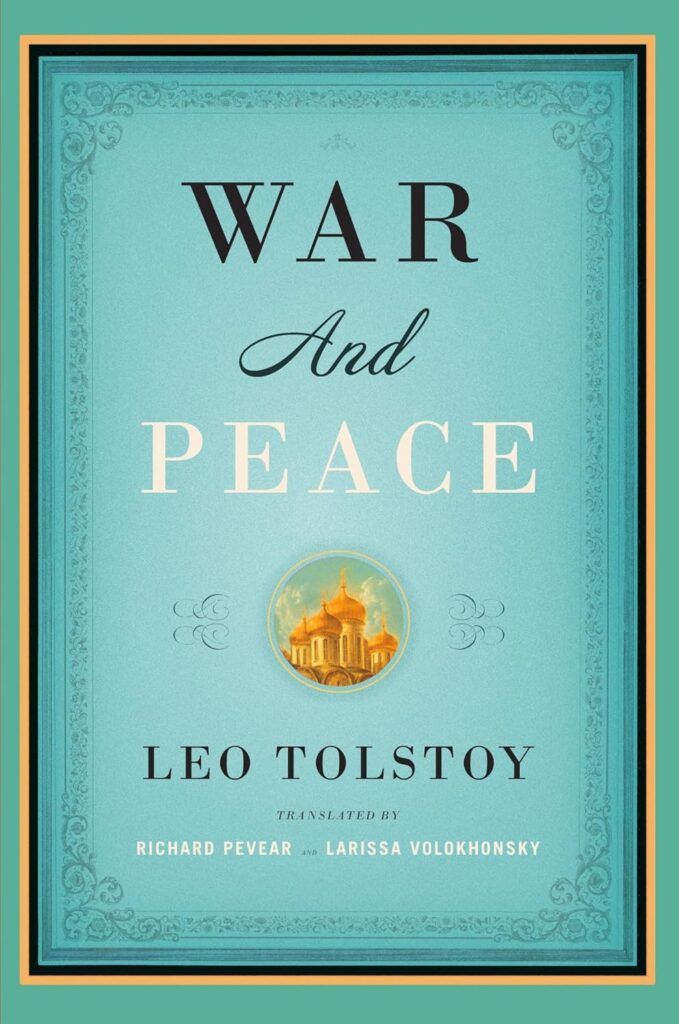
Author: Leo Tolstoy
Description: The foundational classic! There is war, there is peace, and everything in between.
Book length: Colossal (1000+ pages)
Rating: ⭐⭐⭐⭐⭐
Review Part II
Let’s continue! This is the second part of the review where I will go a bit through what Tolstoy aimed for in terms of how history is analyzed, and also some of my subjective reading experience. The introduction, historical context and book structure is covered in the first part.
The Question of Free Will
A big recurring theme in the book is the question of free will and causality of events. I think the best is that I just quote something form the book so you get a feel of the kind of things Tolstoy talks about:
”If the will of every man were free, that is, if each man could act as he pleased, all history would be a series of disconnected incidents.
If in a thousand years even one man in a million could act freely, that is, as he chose, it is evident that one single free act of that man’s in violation of the laws governing human action would destroy the possibility of the existence of any laws for the whole of humanity.
If there be a single law governing the actions of men, free will cannot exist, for then man’s will is subject to that law.
In this contradiction lies the problem of free will, which from most ancient times has occupied the best human minds and from most ancient times has been presented in its whole tremendous significance.”
This is elaborated much more in different sections of the book, often in parallel with the relevant events, and driving examples from history. The main idea is that when we learn history, you often do it through some major historical figures and you try to find reasons why something happened. Sometimes you need to simplify things and you say something like that the war happened because someone gave Napoleon an ultimatum to move his forces away from Prussia, or someone did not abide by some trading regulations Napoleon enforced.
Tolstoy argues that whoever says an event like that was the reason for war or some other big event, is no more right than someone who says that a mountain fell from the last hit of a shovel, after hundreds of kilometers of tunnels under the mountain have already been dug.
I liked those discussions, it is a topic that I find can result in interesting discussions, because it kind of depends on the level you want to analyze things. Especially towards the end of the book, the topic of freedom vs necessity is deeper explored.
Freedom vs Necessity
On the relationship between freedom and necessity, Tolstoy proposes it follows an inverse law. The more you feel something happen due to necessity, the less you feel there was any freedom involved. And vice versa.
Tolstoy argues that the all cases in which our conception of freedom and necessity is increased or diminished depend on 3 things:
1) The relation of the person doing the deed to his/her surroundings
2) The relation to time
3) The relation to causes leading to the action
Freedom vs Necessity – Relation to Surroundings
The point here is analyzing your action as an individual out of context of society versus an individual as a part of society. The analogy Tolstoy gives is the level of freedom a drowning person has versus someone who stands on firm ground. It is obvious which one of them has a greater level of freedom. That translates to living in society. If you want to live with other people, have a family, a job, some hobbies involving other people, you just cannot do whatever you want, at any point of time you like. At least not without consequences. Living in a structured society necessarily means that you agree to do, and not to do, certain things to keep enjoying all the benefits societal life gives you.
Even if you look at someone isolated in their room reading a book, there are levels of necessity in their behavior. What is the temperature in the room, how large is the font (maybe they need to pick up their glasses), the sunlight that shines at objects around – we can see that all of that influences at least in part the actions of an individual. The more of those outside factors you are aware, the less you may feel there is free will involved in some decision making.
The point is, none of us is an individual completely devoid of their surroundings. And this surrounding greatly influences your behavior, even if you are not completely aware of that.
Freedom vs Necessity – Relation to Time
If we look at a particular action that happened moments ago, we are more likely to contribute that action to free will. It seems natural that way, because it just happened, you see the person making a choice. The circumstances under which you made the choice are the same under which you are observing it a minute later.
When you try to judge an action that happened for example a month earlier and under different circumstances, you may see that there were not many different choices you could have made. The further back in time you go, the harder it is for you to imagine your life and everything that happened after, had you not done a particular thing.
Freedom vs Necessity – Relation to Causes Leading to the Action
The order to which we judge a given deed greatly depends on the background and causes that led to that specific deed. When we see someone achieving an extraordinary thing, like completing a difficult climb on a harsh mountain, at first we may be pretty amazed, another person just did something we think we may never be able to. But when you find out that the person had years and years of climbing experience, it starts to make more sense. When you then see they already completed several though climbs before that, and that they are naturally competitive, and in good physical shape, it makes more and more sense that doing the next great challenge is the natural way forward, it was bound to happen.
Another good example are crimes, our opinion on a crime can change drastically once we identify in more detail what circumstances led to the crime. If someone is raised in crime, and saw nothing but crime his/her whole life, is it really entirely their choice when they commit one? Were they not conditioned by life itself to go that route? However, if you just saw a crime, with no background whatsoever, you could say it was their choice to commit it.
This is all closely related to the previous two points – taking into account that you are not alone in the world, and taking into account time. The question of free will is a big one, and has been a topic of philosophical discussion as long as there have been philosophical discussions. I liked that the book explores those questions and gives some very well defined ways of looking at this. Maybe some of this can help us better understand people around us, and our own actions as well.
If you are interested in this topic, I highly recommend reading at least the commentary from Tolstoy (at the beginning or end of the book, depending on the edition). It is only a few pages, and gets the main points across very nicely, leaving you with some good food for thought.
My Reading Experience & Thoughts
This was a big one to tackle and I knew it would take a while. I think that is why I postponed it several times until I found I got the right energy for it. I like reading Russian classics during the winter months, so that is what I did! Napoleon attacking Russia, soldiers being cold, it just makes sense to read it when it’s cold outside, right?
I took my time and read it slowly whenever I caught some time. Some days it would be 10 pages, some 20, some 30. Some days I would not read at all, and on weekends I would have time for some more reading and get 50-100 pages. With that kind of pace, it took me about 2 and a half months to finish it. That is approximately what I was expecting, and I think everyone with jobs or other responsibilities can manage it in 2 or 3 months.
The book is very long, but not a very hard read in my opinion. If you just accept it will take some time to finish and take it step by step, you should be able to read it without much trouble. The number of pages are a bit daunting, but I always liked quality over quantity, so I would rather read one good book than 10 mediocre ones.
I was actually surprised how easy it was to read and how fast I progressed. Tolstoy’s writing is very natural. Combined with the very short chapter length, this makes for a quite smooth reading experience.
Conclusion & Verdict
After finally reading this classic of classics I can say that I see why it holds this position. It really covers sooo much of the human condition that it’s amazing. Love triangles, falling in and out of love, getting married from a variety of perspectives? It’s there. Exploring the sense of justice, pride, and responsibility? You are covered. Relationships with parents? Yep. Putting on makeup and getting ready for a dance or getting wounded on the battlefield? You bet. Getting rich? Getting poor? Death? Entering a secret mystic society? You will not be disappointing.
To be fair, if you read a book that long, you kind of expect to get a lot in return. In any case, I would say it was worth it. I felt I got something out of the book, you know that feeling when you consume a piece of art, and feel that this has enriched your life, be that a book, or movie, a painting, a building…It has that something special, I guess this is why it is considered such a classic.
For the history enthusiast out there, I think this is a must read. I feel the Napoleonic era is an interesting part of history, and it did shape our world we live in quite a bit. The book covers parts of that era, giving some insights from a guy who actually knew and talked to people that took part in the Napoleonic wars. Tolstoy lays out some interesting perspectives on looking at history in general, challenging some well established practices in describing and teaching history, also giving some arguments why some of those perhaps bad practices are really inevitable.
For those not interested in classics, you would skip this anyway. For those on the fence, I would say go for it, but choose a good starting point, when you feel it would be interesting for you to read it. I am anyway of the opinion that you should not force books, or any other piece of fiction for that matter. If you don’t enjoy it at the moment, leave it for some other time, and if that time doesn’t come, so be it. Life is too short to read books you don’t enjoy. If and when the time comes to try it, maybe start at the beginning of the year so you know you have the whole year to finish it!
No book is perfect, and there will be parts that seem a bit boring, especially if you don’t like history. But as a literary classic, War and Peace is as good as they get. With all the interesting characters, exploration of society, and fluent writing, I think it can easily be recommended to everyone to at least give it a try. Who knows, you may have more fun than you expect!
Rating: 5/5
Pros
+ Covers a wide range of human experiences
+ Brilliant exploration of society
+ Challenges how we view History
+ Well written characters
+ Natural, easy to read writing style
Cons
– Very long
– The ‘War’ parts can be a bit tedious
Is War and Peace on your reading list?