Author: Victor Hugo
Description: The french epic historical novel, considered one of the greatest works of the 19th century.
Book length: Colossal (1400+ pages)
Rating: ⭐⭐⭐⭐⭐
The Miserables
This is one of the most famous works of French literature and you would be hard pressed to find someone who hasn’t heard about it. There are numerous adaptations, from movies to TV shows, to musicals. Some adaptations are good, some are questionable, but with so many out there, you would think that the source material is really good. After reading it, I can say – it is! I think this really is a special novel.
It is an epic novel in every sense, lots of great characters, interesting plot, suspense, drama, love, historic battles, detailed description of sewage systems (why not), explorations of human minds in interesting life situations, and satisfying payoffs. All this is set in a fictionalized version of real events in history.
If you watched any of the adaptions you already know the story, if you haven’t, any details would mean spoilers, and this I want to avoid, so in this review I will shortly go through some aspects of the book and give my thoughts about the general reading experience.
Book Length
OK, let’s talk shortly about the number of pages. This book is ginormous. I guess there are longer books out there, but when you talk about mainstream novels, this is pretty much as long as it gets. My copy has about 1400 pages. Some might be discouraged by that right away. If you said to me that there is no way you would read a novel that big, I would totally understand that. Life is too short to read 1000+ pages if you really not feeling it. And that is fine. Actually, it was on my shelf quite long, and it was not easy to get going. With so many pages it just can seem daunting and like a really big project that will take a long time to finish. Finally I gave it a go, and it was hard at the beginning, I remember stopping for a time and reading something else before coming back to it. I think for such a long book it is even good to take a break from time to time and read something else in between.
If you think that there is no chance to get going with this, then it can’t be helped, just skip it. But if you think there is a tiny chance you could see yourself tackling it, I would strongly encourage you to try. I think in the long run you won’t regret it. What can help with such long books (and reading in general) is to try not to think of it as reading 1400 (or whatever) pages, but rather looking at it like this: you want to make reading a regular habit and you want to read some number of pages each day, whether those pages are part of a short or very long book doesn’t really matter. If the book is good and long, you simply have more days with quality reading, so that’s a good thing.
The Standard 19th Century Problem
Something we need to understand about 19th century novels is that many of them were initially serialized. So the complete version we have today is not the version people initially had access to. Back in the day this was their equivalent of TV shows, you would get parts of the story published in weekly or monthly magazines or newspapers. So at the time, you really didn’t know how long the story would be. I imagine it was fun getting the latest chapter and then discussing it with your friends over some drinks.
And same as TV shows today, if a series becomes popular, there would be demand for more. That does not necessarily mean that the novel (or at least its core) did not turn out as the writer intended. But there might be some parts that feel like filler material. So this, as well as the historical social context should be kept in mind when reading classics.
Taking Detours
Speaking of filler material, there are some parts that felt like a drag. There are some pretty big detours from the main story on several occasions, and that can be annoying. They are not necessarily awful to read though. In particular two sections stood out: one large battle description and the description of the sewage systems. With the former, although way too long, I did not have that much of a problem, but the latter was a slog to go through. Those detours can be as big as 50 pages so it’s no joke. Here again we need to think about the serialization that went on. Maybe those filler parts gave the author some time to flesh out the main story. So this definitely is something that could annoy a lot of people, but overall I am not too mad about those parts. Even the mostly boring fillers had one or two interesting bits.
Book Structure and Editions
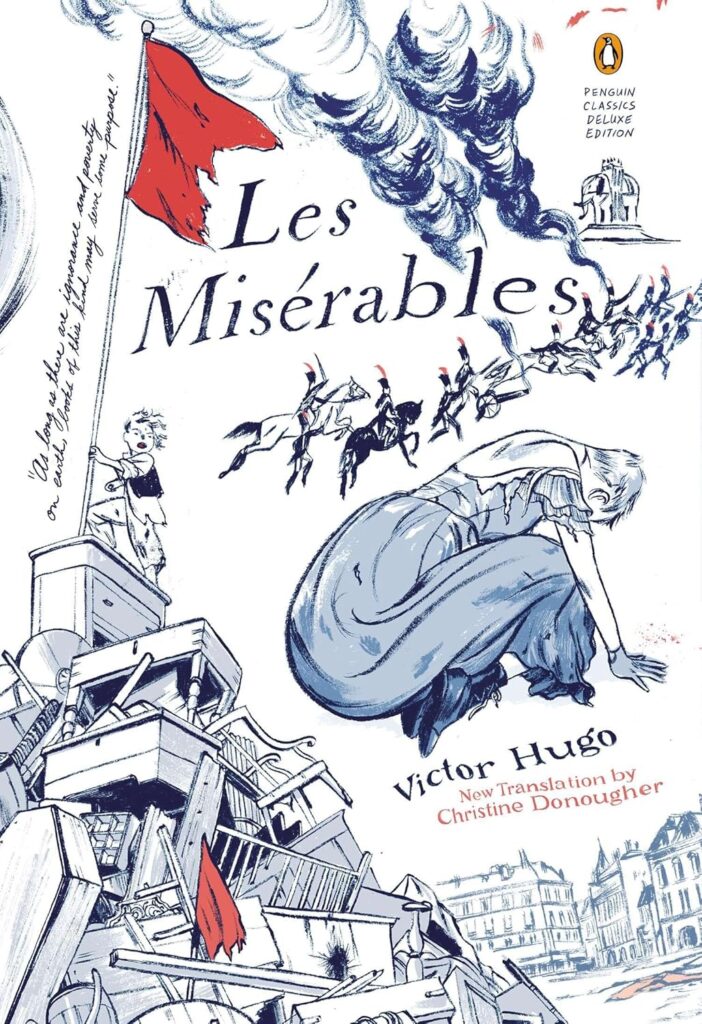
The novel is divided into 5 big parts, roughly the same size. From what I can remember, each part was nicely rounded, and made sense as a part alone, and as a part of the bigger story. Depending on the print, there are versions in one volume and in 5 separate volumes. I read the Penguin Classics Deluxe Edition which is a one volume paperback. The print was very good, the text was crisp and not too small. The fact that it is paperback made it even easier to handle. It is a bit chunky given the number of pages, but definitely fine to read. Overall from pure physical aspects of the reading experience, this is a version I can recommend.
On the Croatian market, there are 2 beautiful editions from Verbum, each in 5 volumes. The first is a paperback variant, with motives from the famous painting Liberty Leading the People by Eugene Delacroix used as cover arts. Each volume can be bought separately. The second variant is hardcover bundle with more minimalist, reddish covers. The books are a bit expensive, but of high quality. There are frequent discounts, so I think it’s worth it. The hardcover especially will last you a lifetime.
Shout out to Verbum for bringing this classic to the Croatian market with such good quality editions!
What to Expect
The novel has a historic setting and takes place during several years in 19th century France, primarily in Paris. There are some real historic events, but they are fictionalized. Or maybe a better way to say it, the real historic events serve as a backbone for the fictional story.
It follows multiple characters throughout its 5 parts. Some stick around longer than others, and at times you will probably not be sure which ones and for how long. The main characters are fairly obvious though, and they all get great arcs. At the core, the novel is about Jean Valjean, an ex convict, who went to prison for stealing bread for his sister’s starving child. At the beginning of the novel Jean is released from prison after 19 years. We follow his attempt to get back into society. As an ex convict his each step is carefully monitored by the authorities, represented by Javert, the cold and calculated inspector who has a black and white approach to justice. Jean Valjean soon meets Fantine, a young working class woman, and their fates intertwine in an interesting way. It is always about the characters, and the story flows so naturally following their motivations.
Through the characters and their struggles, Hugo explores themes of redemption, justice vs law, sacrifice, love, and social inequality, among others. Those are all complex and interesting themes, which I thought were handled really good. There is some profound philosophy in this book.
Although there are parts with some glamour, this is not a novel about the upper echelons of society, as you might have guessed from its title. So expect some not-so-uplifting moments, but also very beautiful ones, as precisely the biggest struggles can bring out the best from within us.
My Reading Experience & Thoughts
It took some mental preparation to start this one. Just considering the sheer number of pages and historic setting, I had to be in a certain mood to get going. Once I did, I found it quite good, although it took some time before I really got hooked. From time to time I took some breaks and later went back to it. When I was reading the main story, I was generally always interested. Some parts where genuinely suspenseful, sometimes making me read even more than I planned for those sessions.
I thought the pacing was generally very good. There are parts when the characters can relax and enjoy a bit, and there are parts where everything turns upside down and you really don’t know what will happen next. For me they those moments were well balanced, giving you and the characters room to breathe, but also keeping you on your toes and not being too predictable.
The overall story was interesting. I had no real complaints, but there were occasional convenient coincidences in the plot. However the real stars are the characters, which are much more important than the story itself.
I really liked the characters, I thought all of the main cast was really well written. Especially Jean Valjean, who may even be my favorite fictional character. He just has such a good arc, and his moral struggles and inner dialogues were highlight moments of the novel for me. I also have to mention Javert, who was a great counterpart to Jean throughout the story.
Conclusion & Verdict
Les Misérables is widely considered to be a masterpiece, and with that I wholeheartedly agree. It’s not without its faults, like everything, but all objections I have do not take away much. It has become one of my favorite novels of all time. The size of the novel means it can take its time, and thoroughly explore all the interesting characters and profound themes, giving great payoff moments in the process.
It has great characters, an interesting story, you learn some history (or at least be encouraged to check it out further yourself), and it explores profound themes that are at the core of what it means to be human. Even though I like the challenge of reading long books, rarely do I get the urge to re-read a very long story. In this case, however, I can see myself reading it again some time. I am sure that when I do, I will get something new out of it.
Hopefully I managed to convince you to at least give it a shot at some point. If you are not into classics, then there is no point in forcing it, and simply skip it. But if you think about tackling this one, I encourage you to go for it. You will be in for a treat. It is one of those that I wish I could experience again for the first time, but at the same time I’m glad I read it and look forward to reading it again.
Rating: 5/5
Pros
+ Great, compelling characters
+ Interesting story
+ You can learn some actual history
+ Explores deep themes like redemption, justice, sacrifice, love, and morality
Cons
– Very long, which can discourage a lot of people
– Long detours from main story
– At times too much conveniences in the plot
“You ask me what forces me to speak? a strange thing; my conscience.”