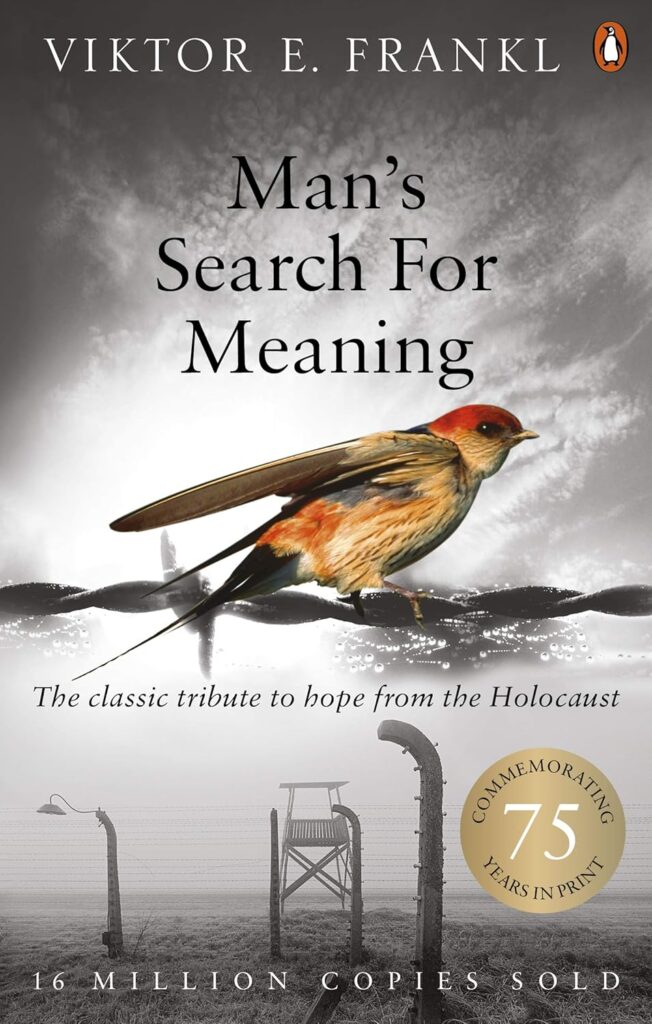
Author: Viktor E. Frankl
Description: Real life account of a Holocaust survivor. How people can find hope and reasons to live even in the most desperate circumstances.
Book length: Short-Medium (~130 pages)
Rating: ⭐⭐⭐⭐⭐
Introduction
The question of meaning is one of the deepest we can ask. As a human it is difficult not to ask it and somehow answer it for yourself, with perspectives changing over time. I would say that our ideas and hopes about meaning are also heavily influenced by our upbringings, people that surround us, and life circumstances. Is meaning something we should search for, or something we should create for ourselves?
Viktor Frankl was an Austrian neurologist, psychiatrist, and a survivor of Nazi concentration camps, including Auschwitz. In this book he provides a sort of memoir or short autobiography, telling the story of his time in the camp in a very honest and straightforward manner. In those reflections he also discusses questions of meaning and what gave him strength in those moments when all hope seemed to be lost. As someone who actually studied human psychology and biology before his imprisonment, had to go through the suffering with other prisoners, managed to survive all this, and finally used this experience to continue his work and help other survivors, he was able to present unique and valuable insights into human psychology and our search for meaning.
I think this is a book everyone should read.
Book Structure & Writing Style
This book is often seen in top lists of self-help titles. Self-help as a category is quite loose and the market is over-saturated with average or below average texts, often written by journalists or entrepreneurs. That’s not to say that an entrepreneur is incapable of creating a good self-help book, but more often than not, we see titles that have one or two decent ideas, and then add 80% filler material to be able to sell it as a book. In that sense, Man’s Search for Meaning is on a completely different level. The writing is very honest and straight to the point. It feels that there really is no filler material, each sentence serves it’s purpose. It doesn’t feel like someone is trying to sell you some BS, but rather genuine advice learned through professional training and personal experience. The book is very readable in terms of pure readability, however the content of the text can be quite heavy. If you are easily disgusted, be prepared to read some disturbing content. With this subject matter and heavy themes, this is expected.
There are 2 main sections in the book. The first part is mainly the autobiographical part where the events in the concentration camps are described, and this accounts for roughly 3/4 of the book. In the second part the author lays out the key principles of logotherapy, his own developed method of psychotherapy, where also some concrete advice on the question of meaning is presented.
My copy had about 130 pages, with a generous font size. If you are a fast reader you can probably read it in a day, and certainly in one weekend, without sacrificing too much of the weekend. You will, however, probably find that you want to think about certain sentences for several moments to process them.
Concentration Camp Experience
The bulk of the book tells the story of how Frankl’s life looked like in the concentration camps. It is not a detailed description of all the events and facts, but rather a very personal story. So the events are presented more as episodes showcasing specific situations and how he experienced them, rather than a linear overarching narrative.
It starts with the arrival at the camp and the initial shocks, following a state of apathy that prisoners develop as an important mechanism of self-defense in those conditions where death and suffering is at all times around you. He describes situations involving the struggles with food – the thing that occupied the minds of prisoners most of the day, as their only meal in a day was a piece of bread and a bowl of soup. On top of such hunger, they had to do physically draining work, often soaking wet. Their shoes would be constantly full of water and ice, feet so swollen that each step was agony. And on top of all that, there was the constant danger of sadistic guards, for which inmates were just numbers.
Frankl describes the life in barracks, the lack of space, the lack of privacy and hygiene. The state of mind a prisoner enters, where the only mission is to save your life. How it becomes easy to send another human to death if that means saving yourself or a friend. We see strategies for survival like trying to be as inconspicuous as possible, rushing to the middle of groups during marches, as the first and last lines were the easiest targets for guards. Each day a new struggle for survival. As Frankl put it: ”in a camp a day lasted longer than a week”.
A section that stood out to me was something Frankl said he would never forget. One night he was awakened by the groans of a fellow prisoner who was shaking in his dream, obviously from a nightmare. He wanted to wake him up, but stopped his arm, terrified of his intend to wake him. He realized that whatever nightmare the man had, however horrible it was, it could not be any worse than the reality which they found themselves in.
He touches upon other topics like how they coped with faith, art, and humor in the camps. How each moment there were decisions to be made that could mean the difference between life and death. Despite being held captive at that terrible place, he makes the case that human freedom is not solely under the influence of outside conditions.
What is Freedom?
Frankl gives us some examples to show that humans always have a choice how to act. Even in the environment of concentration camps, there were prisoners who shared their last piece of bread and words of encouragement. They were rare, but it shows the resilience of the human spirit. Even though that is admirable, it may have not been the best strategy to survive, and Frankl says himself: ”The best of us did not make it out alive”. Here it is not the question of should you be a good person in the camp, as hardly anyone can blame someone for trying to save his life in those conditions, it is more the question of can you find the strength to see that you always have a choice, and do what you think is right to move forward.
I think the discussion about freedom is more an individual, personal thing. The point that was made was that we cannot choose what life throws at us, but we can choose how we will respond to that. And in that lies the true meaning of freedom – choosing what will become of us no matter what happens. The way we accept our destiny presents a great opportunity to give our lives meaning, even in the hardest of times.

Frankl explained that the individuals who lost their inner control, their sense of morality and inner freedom were those that got corrupted and bested by the outside influence of the camp. The ones that managed to keep this inner control where the ones that found something in the suffering that kept them going.
An example from the book about the acceptance of suffering that stood out to me was a story of a man who lost his wife. He came to Frankl and told him how much he was suffering for the past years because of that. When Frankl asked him how his wife would feel if the situation was the other was around, the man realized she would be the one who had to suffer the loss. In her being the first to go, he spared her that suffering, but the price for that is that he had to outlive and mourn her. Suffering becomes more bearable once it gets a purpose.
Logotherapy
In the second main section of the book the main ideas of logotherapy are discussed. Logotherapy is a form of psychotherapy developed by Frankl himself, and is also called the ”Third Viennese School of Psychotherapy”, along with Freud’s psychoanalysis and Alfred Adler’s individual psychology. The name comes from the Greek word logos, which means meaning. The main principle is based on the premise that finding meaning in life is the primary motivational force of an individual.
This type of psychotherapy is still widely used, and there are many logotherapy institutes around the world.
What is the Meaning of Life?
Here I will shortly lay out what I thought were some good messages from the book.
The question of meaning of life in a general way is similar to asking a chess grandmaster what the best possible move in chess is. There is no general best move, or even a general good move, it all depends on the specific situation, how the board looks like at that moment, and who your opponent is. The same is true for human existence.
We should not try to look for some abstract meaning of life. Each of us has a specific, unique mission in this world. The meaning of life is different for each person and also changes with time for each person. Each moment presents a choice, therefore the question of meaning could also be reversed. We should not ask what the meaning of life is, but understand that we are the ones being asked. Life is asking each of us a question, and we can answer by responding to life and taking on responsibility.
The book lays out 3 main ways how we achieve meaning:
1) Accomplishing a deed or executing an act
2) Experiencing something or meeting somebody
3) The position we take when faced with suffering
The meaning of love, suffering, and transience of life are then further discussed in the book, always in a clear and concise matter.
Conclusion & Verdict
This is one of those books that gets an almost universal praise, whatever list of ”best books to read” you look up. And there is good reason for that. It terms of self-help books this one that can give you some actual advice and change of perspective on life. Even if you are not interested in this psychological or philosophical aspects, there is still a personal story of how the author survived his time in the concentration camps.
The book is not too long, it is written from first hand experience, there is no unnecessary filler text, and it tries to give concrete answers to deep questions about the meaning of life and how to find purpose in suffering. It overall feels very genuine, and does not try to force upon you a personal philosophy or belief. The author is a medical doctor specialized in neurology and psychiatry who went himself through Hell on Earth, through that experience, and through the experience he has in treating patients he presents in this book his best attempt on dealing with questions of meaning.
Man’s Search For Meaning is one of the best books I have read and an easy recommendation for everyone.
”He who has a Why to live for can bear almost any How.”
Friedrich Nietzsche
Rating: 5/5
Pros
+ Profound philosophy
+ Honest and to the point
+ Written by an expert on human psychology
+ Actual practical advice
+ Not too long
Cons
– Nothing worth mentioning
Idem odmah na Libristo po knjigu, hvala na preporuci!
Nema na cemu! Mislim da neces pozaliti, zelim ugodno citanje!